
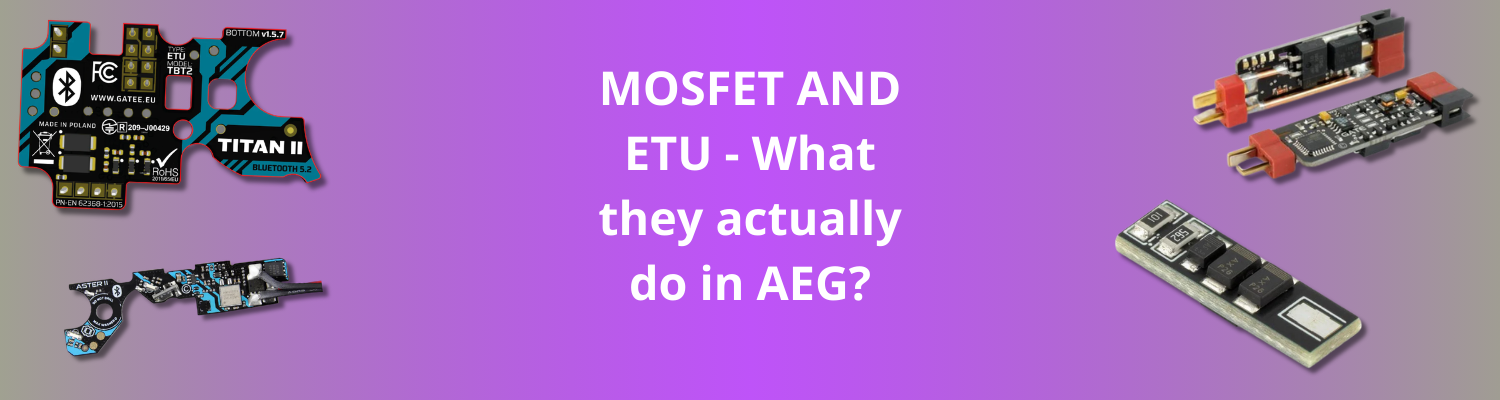
When talking about electric airsoft guns (AEGs), you’ll often run into terms like MOSFET and ETU. For many players they’re just “some electronics” that either come pre-installed in the gun or are something people recommend upgrading to — but fewer people actually know what they do and whether they’re useful for their own setup.
In this article we’ll cover:
- what a MOSFET means in an airsoft gun and what it does
- what an ETU is and why it’s not the same thing as a basic MOSFET
- what real-world benefits these bring in everyday use (reliability, durability, trigger feel)
- when retrofitting makes sense, and why it’s often a small but worthwhile upgrade
What is a MOSFET?
In an airsoft AEG, a MOSFET is essentially an electronic “power switch” that routes the high current required by the motor through the MOSFET, instead of sending it directly through the trigger’s mechanical contacts. In a traditional AEG, the trigger controls the current through those contacts, and when a lot of current is flowing (especially with higher-performance batteries and heavy use), the contacts start to spark and burn, which carbonizes the contact surfaces. For the user, this often shows up as intermittent firing, inconsistent semi-auto performance, or eventually a complete contact failure.
The core idea of a MOSFET is simple: it reduces the load and wear on the trigger contacts, improving reliability and extending their lifespan. At the same time, it’s good to remember that a MOSFET doesn’t make mechanical contacts “immortal” — they’re still physical parts that can wear mechanically, get dirty, or eventually need attention even if electrical stress is reduced. That’s why sensor-based solutions (such as optical or magnetic trigger sensing in ETU units) are often more long-lasting specifically in terms of avoiding “trigger contact” issues, because they don’t rely on metal-on-metal contact in the same way.
Another common misconception is that a MOSFET is always just a “simple protection circuit.” While basic models exist, there are also programmable and feature-rich MOSFETs on the market, which can include different fire modes, adjustability, and battery protection.
What is an ETU?
An ETU (Electronic Trigger Unit) is an electronic trigger unit that reads the trigger pull using a sensor and controls the motor through electronics. This is why ETUs are often casually referred to as “MOSFETs,” but an ETU is not just a power switch: it also includes control logic that defines what a single trigger pull should do and when power should be cut.
Trigger detection is typically done optically or magnetically, depending on the system. The key advantage is that the “trigger signal” can be generated without a traditional metal contact, so sparking and burning of contact surfaces are not the same kind of issue. In practice, this often means the system is less sensitive to contact-related problems.
The “smart” side of an ETU shows up in how it can manage the firing cycle more precisely than a mechanical switch. At the same time, ETUs often enable features and adjustments such as burst modes, trigger sensitivity settings, active braking, in some cases pre-cocking, and often battery protections (such as low-voltage protection).
What are the practical benefits?
A MOSFET’s biggest real-world benefit is durability and reliability. When the motor’s load current doesn’t run through the trigger contacts in the same way, the contacts spark less and don’t wear out as quickly. This reduces intermittent firing and contact failures, and makes the gun’s electrical system more worry-free — especially when using higher-performance batteries. In addition, a MOSFET can improve the efficiency of the electrical system for a simple electrical reason: a mechanical trigger switch and its contact surfaces often introduce more resistance and therefore more voltage drop. When that loss is reduced, the motor can receive power more effectively from the battery, which can show up as a shorter trigger delay and, in some setups, an increase in rate of fire. The size of the effect depends a lot on the gun’s starting condition.
An ETU’s biggest practical benefit is programmability. An ETU allows you to tailor how the gun behaves to your own use without mechanical tinkering: you can adjust and switch between different firing modes (e.g. burst, binary), limit rate of fire, modify trigger behavior, and use active braking and pre-cocking. Many ETUs also include protection and diagnostic features that make everyday use easier. For example, ASTER II can connect via Bluetooth to a phone app, letting you view historical data from the gun, program features easily, and check diagnostic information if something goes wrong.
When should you retrofit a MOSFET or an ETU?
Many newer AEGs come with a MOSFET or an ETU from the factory, but there are still guns on the market with neither. Retrofitting is often a sensible “small upgrade” because it improves everyday reliability and can add features you wouldn’t otherwise get without bigger internal work. When a MOSFET can cost as little as around €30 and entry-level ETU units around €45, the barrier is usually fairly low.
A MOSFET is worth retrofitting if the gun still uses traditional trigger contacts and you use a higher-performance battery. It’s also a good preventative upgrade — the contacts don’t need to be broken yet for the installation to make sense.
An ETU is worth retrofitting if you want a contactless trigger on top of clearly more adjustability and features. It’s especially sensible if you want to tailor fire modes/features to field rules or your own play style, or if you value being able to manage settings and possible error indications through software.


