
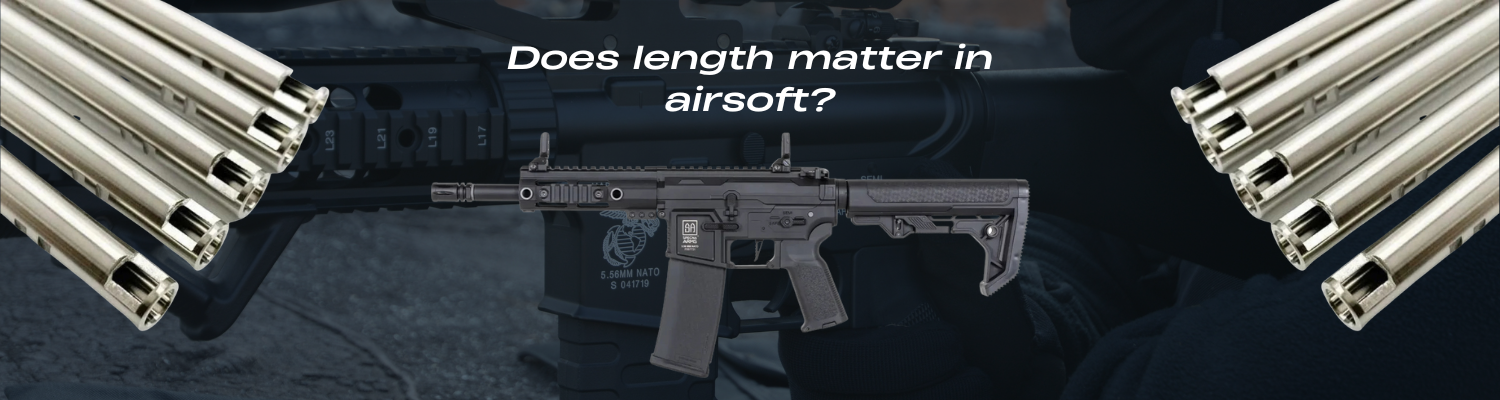
When you look at airsoft guns on a shelf or in an online store, one of the most obvious differences is length. Some models are short and agile, others long and “rifle-like” — and a common question naturally follows: does a longer model actually have an advantage, will it shoot farther, or be more accurate?
In this article, we’ll dig into what inner barrel length really does in airsoft, why the effect depends on the power source and other parts, and how to interpret barrel-length differences between models before making a purchase decision or modifications.
What inner barrel length affects
Inner barrel length primarily affects how long the BB remains under acceleration inside the barrel, and at what point the air/gas has time to “do its work” before the BB exits. In practice, this can show up in muzzle energy (joules) and sometimes consistency — but that doesn’t mean barrel length automatically equals range or accuracy. In airsoft, range is built mainly around hop-up performance and BB choice, and accuracy is more about how consistently the system produces the same shot time after time. That’s why two different models can behave surprisingly similarly even if their inner barrel lengths differ a lot — and on the other hand, in some setups a small change in length can clearly change energy or “feel.” Which one happens depends especially on the power source and whether the system’s air output is matched to that barrel length.
Muzzle energy and muzzle velocity
Inner barrel length can change muzzle energy and chrono readings because it determines how long the BB stays under acceleration. But whether energy increases, stays the same, or even drops always depends on whether the system’s air/gas can keep doing useful work along the full barrel length. When the “push” is sufficient, a longer barrel can raise energy or improve efficiency. When the push runs out too early, extra length no longer helps — and in the worst case the BB travels the remaining distance more under losses (friction, air leaks, pressure collapse) than under effective acceleration. That’s why the same barrel-length difference can show up dramatically on the chrono in one model, and barely at all in another.
Sound and feel
Many people notice the effect of barrel length first in sound and shot feel, because length changes when and how pressure vents out of the barrel. With a shorter barrel, pressure vents “earlier,” which often emphasizes a sharp report and makes the shot louder at the muzzle. A longer barrel can soften the sound or change the tone, because the pressure pulse behaves differently before it exits. It’s worth keeping this separate from performance: a change in sound mainly reflects how pressure is venting, not that range or accuracy has automatically improved. That’s why two barrel lengths can sound very different even if the difference on target is small.
Range and accuracy
When it comes to range and accuracy, barrel length is rarely the main explanation, even though it’s easy to assume it is. In airsoft, range is mostly created by how the hop-up gives the BB controlled backspin and how well the chosen BB supports that; length influences this only indirectly if it changes energy or shot consistency. Accuracy, in turn, is primarily about repeatability — how similar each shot is to the next. Here, barrel quality and tolerances, as well as hop performance, often matter more than length, because a consistent inner surface, straightness, and a well-finished muzzle crown affect whether the BB exits the barrel the same way every time. Length can support a good overall setup, but it rarely compensates for poor hop-up, BB choice, or inconsistent barrel quality.
AEG: barrel length is always “as long as your air volume”
In an electric gun (AEG), the importance of inner barrel length is essentially tied to how much air the cylinder can deliver as usable pressure behind the BB. An AEG doesn’t generate more “push” just because the barrel gets longer — the cylinder’s air volume and the piston stroke determine how much air is available for the shot. When the barrel length is well matched to that air volume, the BB receives smooth acceleration and the system runs efficiently. When the barrel is significantly longer without the air side being matched accordingly, acceleration can start to fade before the muzzle and energy no longer increases as expected.
For that reason, in an AEG you shouldn’t interpret barrel length with a simple “longer is better” mindset. It’s more a sign of what kind of overall system the gun was designed for. Two different models may use different cylinder types precisely because their barrel lengths differ — and then barrel length alone doesn’t tell you which is “better.” The key is compatibility: if the air volume and barrel volume are in a sensible relationship, you can actually benefit from the length.
Gas/CO2: why barrel length often shows more clearly
In gas-powered guns, inner barrel length often feels like it “really matters,” because the force accelerating the BB is produced differently than in an AEG. The shot isn’t based on one fixed amount of air; instead, expanding gas flowing through the valve can keep doing work behind the BB for as long as the BB remains in the barrel. Because of this, a longer inner barrel can, in some setups, increase measured energy or change behavior more clearly than in an AEG — at least until pressure drops or flow starts to become limited.
This is also where joule creep often comes up. The effect is not “only a gas gun thing,” but it can appear whenever a system can keep transferring energy to the BB even after a lighter BB would already have left the barrel. In practice, a heavier BB accelerates more slowly and stays in the barrel longer, giving the system more time to do work behind it — and as a result, measured energy can be higher with a heavier BB. In gas guns (and often in HPA setups) this tends to stand out because pressure and flow behave more “continuously” during the shot, but the principle is the same: barrel length and how long the BB remains in the barrel determine how much energy can be transferred.
That’s why, in gas guns, barrel length is best interpreted primarily through energy and efficiency — and it makes the most sense to think about energy with the BB weight you actually play with. The core logic is still the same as in an AEG: length only helps if the system can take advantage of it — but on gas, the “usable range” and the likelihood of noticeable joule creep are often more obvious.
HPA: barrel length is tuning range, not destiny
In an HPA system, inner barrel length rarely locks performance in the same “fixed” way as in an AEG or gas gun, because the whole point of HPA is adjustability. With compressed air and a system where valve open time and the amount of air delivered can be controlled, barrel length becomes more like one tuning knob: it can be used to target a desired energy level, efficiency, and behavior, but length alone doesn’t decide the outcome.
In practice, a longer barrel gives more time and distance to transfer energy to the BB, so in some setups you can reach the same joule level at lower pressure or with less air consumption. On the other hand, if you feed too much air relative to barrel length, the extra air mostly turns into wasted air and noise — and joule creep can become more pronounced because a heavier BB stays in the barrel longer and has more time to receive energy. That’s why in HPA there isn’t a single “right” or “wrong” barrel length: it’s part of a system where pressure, dwell, and BB choice determine what you actually get from that length.
One of HPA’s strengths is that if barrel length changes (or you choose between models with different barrel lengths), you can usually tune performance back to the desired level without having to change the mechanical “air volume” in the same way you would in an AEG. For that reason, barrel length in HPA often shows most clearly in efficiency, air consumption, and how easily the setup can be made consistent with your chosen BB weight and energy target.
What usually matters more than barrel length?
If the goal is better range and a cleaner grouping, inner barrel length is rarely the biggest single factor. More often the result is decided by how well the entire system works together: the hop-up applies consistent backspin, the BBs are high quality and an appropriate weight, and the air/gas delivery is as consistent as possible shot to shot. If any of those are uncertain, the effect of barrel length tends to be small or hard to interpret.
The first — and usually most important — system is the hop-up. If the hop-up rubber applies pressure unevenly or behaves differently from shot to shot, the trajectory will vary regardless of whether the barrel is 229 mm or 363 mm. Second comes BB quality and weight: a consistent BB produces a more stable flight path and makes hop performance more predictable. Third is air seal: if air leaks at the hop unit, nozzle, or seals, energy and repeatability fluctuate, and that shows up on target.
A factor that often matters more than barrel length is barrel quality. Higher-quality aftermarket “precision” barrels often have tighter and more consistent tolerances, better materials, and more careful finishing. In practice this usually shows up as better repeatability: the BB travels more predictably and exits the barrel more consistently, so groupings tend to “clean up” more readily than from a length change alone. At the same time, it’s worth understanding that tighter tolerances can make the setup more sensitive to BB quality and cleanliness — the best gains come when the hop-up and BBs are at the same level as the barrel.
When these factors are in place, barrel length falls into the right perspective: length affects energy and efficiency matching, but for hits and groupings, what usually matters more is how consistently the whole system produces the same shot time after time.


