
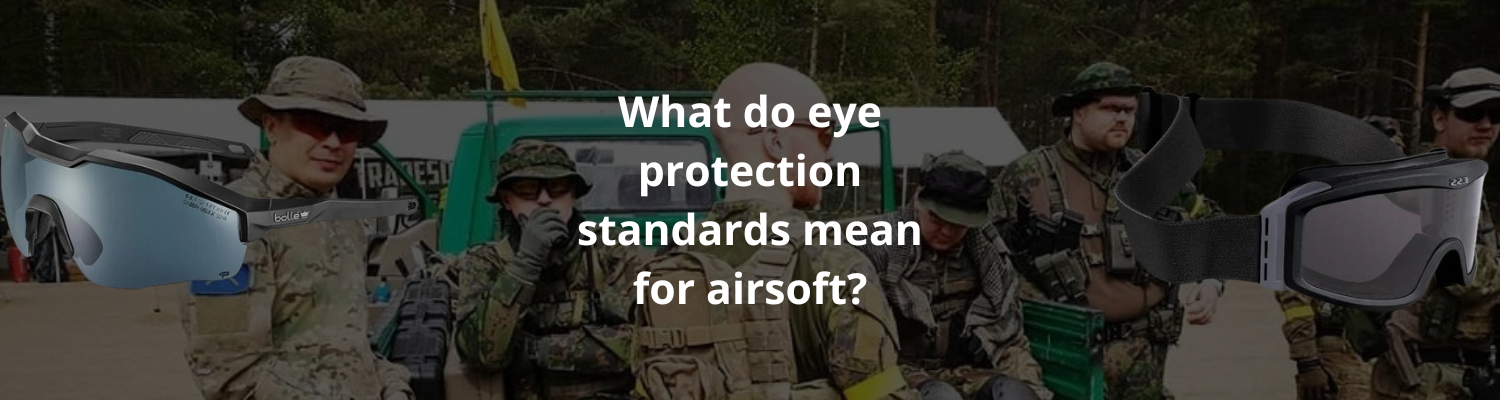
There is a huge range of eye protection on the market, from inexpensive work safety glasses to tactical ballistic eyewear. The problem is that it is not always obvious whether a given model is suitable for airsoft use. Many products reference standards such as EN 166, ANSI/ISEA Z87.1, or MIL-PRF specifications, but what do these markings actually mean in terms of withstanding airsoft BB impacts?
If you buy your eye protection from our selection, you can do so with confidence. Every model we sell is suitable for airsoft use. If we have ever had doubts about a model before putting it on sale, we have tested it ourselves to confirm it can handle airsoft impacts.
In this article, we break down the most common standards in a technical but practical way. We explain how they are tested, what they really guarantee in an airsoft context, and what you should treat as the minimum baseline for safer play.
EN 166
EN 166 is the most common baseline standard for eye protection in Europe. For impact resistance, the key point is that EN 166 uses an impact class, usually shown as a letter:
-
S
-
F
-
B
-
A
-
you may also see T, which indicates the same impact class was also tested at different temperatures
For airsoft, B and A are generally the markings worth looking for.
How is it tested and what do the numbers mean?
EN 166 impact classes F, B, and A are based on a test where the protector must withstand a 6 mm steel ball impact. The steel ball mass is about 0.86 g.
-
F: 45 m/s
Energy is about 0.87 J. In “airsoft energy terms”, this corresponds to roughly 92 m/s with a 0.20 g BB. -
B: 120 m/s
Energy is about 6.19 J. This corresponds to roughly 250 m/s with a 0.20 g BB. -
A: 190 m/s
Energy is about 15.5 J. This corresponds to roughly 394 m/s with a 0.20 g BB.
EN 166 also includes class S, which is based on a 22 mm steel ball drop test. Its energy level is about 0.56 J.
How does this apply to airsoft?
EN 166 is useful for airsoft for two reasons. First, the test projectile diameter is close to the airsoft BB size, so the impact is in the same general size category. Second, a steel ball is stiffer than a plastic BB, so the test load is conservative in many practical ways.
A realistic interpretation is:
-
The label EN 166 alone is not enough. Look for the letter class that indicates the impact level.
-
EN 166 F is close to a one-joule energy level. It is not a strong standalone signal if you want confidence at fields where the limit is around three or four joules.
-
EN 166 B provides significantly more margin in energy terms and is therefore a much stronger choice when you specifically want impact resistance for airsoft.
ANSI/ISEA Z87.1-2020: Z87 vs Z87+
ANSI/ISEA Z87.1 is a US standard for eye and face protection. For airsoft, the most important detail is this:
-
Z87 indicates a baseline level.
-
Z87+ indicates the protector has been tested and approved for high impact requirements.
If a product is marked only Z87, it does not mean the same thing as Z87+. This is one of the most common misunderstandings.
How is it tested and what do the numbers mean?
1) Baseline Z87: drop ball test
At the baseline level, the lens is tested with a drop impact:
-
steel ball diameter 25.4 mm
-
mass 68 g
-
drop height 1.27 m
Energy is about 0.85 J, which corresponds to roughly 92 m/s with a 0.20 g airsoft BB in energy terms.
2) Z87+: high impact requirements
Z87+ requires several tests. Two of the most relevant for airsoft interpretation are:
a) High mass impact
-
a 500 g pointed object
-
drop height 1.27 m
Energy is about 6.23 J, corresponding to roughly 250 m/s with a 0.20 g BB in energy terms. This test also stresses the frame and retention, not only the lens.
b) High velocity impact
The standard commonly uses a 6.35 mm steel ball with a mass of about 1.05 g, with different speeds depending on protector type:
-
safety spectacles: 45.7 m/s, about 1.10 J
-
sealed goggles style: 76.2 m/s, about 3.06 J
These are directly meaningful for airsoft because they fall into the same broad energy ranges as many field limits, and the steel projectile generally produces a more demanding impact than a plastic BB at the same energy.
How does this apply to airsoft?
If you want one practical rule, it is this: look for the plus.
-
Z87 indicates a baseline level, but it does not by itself provide strong confidence if you want a clear safety margin in airsoft.
-
Z87+ indicates the protector has been tested against more severe impact types. The “goggles” high-velocity test energy is close to three joules when using a steel ball.
You should still consider structural suitability. Spectacles may be Z87+ yet leave side gaps that allow ricochets or fragments to enter.
MIL-PRF-32432A
MIL-PRF-32432A is a military performance specification for ballistic eye protection. You typically see it in products marketed for professional or duty use, and these products often have stronger documentation.
Be careful here. The market also includes other similar MIL references and older wording that can be confusing.
How is it tested and what do the numbers mean?
The core idea in MIL-PRF-32432A is to simulate fragment impact using a small projectile. A commonly reported test setup is:
-
projectile size 0.15 caliber
-
mass 0.379 g
-
speed range is typically reported by manufacturers as roughly 195 m/s to 221 m/s, depending on product type and classification
In this range, energy is about 7.2 J to 9.3 J.
If you convert that energy to a 0.20 g airsoft BB equivalent, the corresponding speeds would be roughly 270 m/s to 305 m/s. This gives the scale. The projectile used in the test is also significantly smaller than a 6 mm BB, so the load is concentrated on a smaller area and can be extremely demanding locally.
How does this apply to airsoft?
When a product has genuinely been tested to MIL-PRF-32432A, it typically provides a very large safety margin for airsoft. The energy level is well above most field limits, and the test projectile is demanding due to its size and material.
A critical reminder: “ballistic” can be a marketing term. MIL-PRF-32432A is only meaningful if it is clearly specified and supported in technical documentation.
As an example of a “well documented” stack of markings, ESS lists compliance for Crossbow eyewear with MIL-PRF-32432A, ANSI/ISEA Z87.1-2020, and EN 166.
ASTM F2879-19
ASTM F2879 is an eye protection standard aimed specifically at airsoft participants. It deals with 6 mm airsoft projectiles and aims to reduce eye injuries from impact and penetration.
For airsoft, this standard has a valuable difference compared to many industrial standards. It does not only ask whether a lens survives an impact. It also focuses on whether the system stays intact and whether the eye area remains protected after the impact.
What does the standard require technically?
The mechanical requirements emphasize failure criteria such as:
-
the airsoft projectile must not pass through or bypass the protector
-
the lens must not detach from the frame during impact
-
retention components must not detach
-
parts of the protector must not contact the eye socket area on the test headform
-
the protector must not develop an opening through which a 4.5 mm probe can reach the eye socket area
-
ventilation holes and other openings are evaluated using the same 4.5 mm probe
These criteria are exactly what separates airsoft-oriented protection from generic safety glasses. In airsoft, ricochets and fragments are relevant, so controlling openings and maintaining lens retention are critical.
How does this apply to airsoft?
ASTM F2879 is the most directly airsoft-specific reference, but it has one practical issue: the marking is often not printed on the product itself. It is more commonly found on the manufacturer’s product page, in the manual, or in technical documentation.
If you find a product that is clearly stated to comply with ASTM F2879 and the manufacturer can support that claim credibly, it is a very strong signal of airsoft suitability.


