

How far can an airsoft gun shoot? Airsoft range explained
How far can an airsoft gun actually shoot? There is no single range that applies to every airsoft gun. In our own practical range test, a 0.89 J pistol firing 0.32 g BBs reached 55 metres, while a 3 J VSR firing 0.45 g BBs was still producing good hits at 90 metres. Between those two extremes, the tested guns produced very different results depending on their power, BB weight, hop-up performance and overall consistency.
The most important distinction is this: how far a BB can travel is not the same as how far you can hit reliably.
Hop-up performance, BB weight, muzzle energy, shot-to-shot consistency, wind and the quality of the whole setup all affect practical range. This article explains what airsoft range really means and uses our seven-gun range test as practical examples.
Airsoft range is not just one number
When someone says that an airsoft gun “shoots 80 metres”, the statement can mean several very different things. Before comparing guns, it helps to separate three types of range.
Maximum flight distance
Maximum flight distance simply means how far the BB travels before reaching the ground. A BB can be launched on an arcing trajectory much farther than the distance at which the gun can be aimed accurately at another player.
This makes maximum flight distance a poor measure of actual performance on the field.
Maximum hit distance
This is the longest distance at which a hit can be achieved. A single successful hit can demonstrate that the BB reaches the target, but it does not necessarily mean the gun can repeat that hit consistently.
Our 2.7 J DMR firing 0.40 g BBs is a good example. We achieved a hit at 85 metres, but the spread had already become large enough that repeating the result was difficult.
Effective range
For gameplay, effective range is usually the most useful measurement. It describes the distance at which the gun can produce reasonably repeatable hits on a player-sized target.
A gun that reliably hits at 70 metres can therefore be more useful at range than another gun that occasionally reaches farther but scatters BBs across a large area.
We tested seven different airsoft guns
For our practical test we used seven different airsoft guns, a rangefinder, multiple cameras and a player-sized target. The goal was deliberately to push each setup towards its maximum hit distance rather than measure a controlled laboratory-style grouping.
The guns differed in muzzle energy, BB weight, hop-up setup and other characteristics. The results should therefore be treated as real-world examples of these particular setups rather than universal specifications for each model or weapon type.
| Tested gun | Muzzle energy | BB weight | Hit distance | What we observed |
|---|---|---|---|---|
| Umarex Glock 19 | 0.89 J | 0.32 g | 55 m | Still produced reasonable hits and reached surprisingly far for its power level. |
| NOVRITSCH SSX23 | 1.1 J | 0.36 g | 65 m | Still produced fairly good hits at 65 metres. |
| Tokyo Marui AKX | 1.1 J | 0.32 g | 56 m | Reasonable hits despite the hop-up not being perfectly adjusted during the test. |
| Upgraded M16 | 1.3 J | 0.32 g | 73 m | The BBs travelled far, but the spread became large and hits were difficult to repeat. |
| MTW | 1.7 J | 0.36 g | 70 m | Very consistent performance with relatively little spread at the tested distance. |
| Upgraded DMR | 2.7 J | 0.40 g | 85 m | A hit was achieved, but repeatability was already poor because of the large spread. |
| VSR | 3 J | 0.45 g | 90 m | Produced good hits at 90 metres and the BBs still had noticeable energy remaining. |
The important point is not which gun produced the largest number. The 1.3 J M16 firing 0.32 g BBs reached 73 metres, while the more powerful 1.7 J MTW firing 0.36 g BBs was tested at 70 metres but produced clearly more consistent results. Likewise, the difference between the 2.7 J DMR at 85 metres and the 3 J VSR at 90 metres was only five metres on paper, while their practical performance at those distances was very different.
The figures also show why muzzle energy alone cannot be converted directly into a range figure. A more powerful gun does not automatically produce a longer maximum hit distance in every test, and the longest individual hit does not automatically represent the most useful range.
Can an airsoft pistol really shoot more than 60 metres?
Our pistol results were some of the biggest surprises in the test. The Umarex Glock 19 produced 0.89 J with 0.32 g BBs and was still able to hit at 55 metres. The NOVRITSCH SSX23 produced 1.1 J with 0.36 g BBs and reached 65 metres while still producing fairly good hits.
This demonstrates why power alone cannot be used to predict range. A relatively low-powered gun with a well-functioning hop-up and a suitable BB can send BBs much farther than many players expect.
It does not mean that every gas pistol will reliably hit at 60 metres. Different hop-up systems, BB weights, temperatures, gases and individual guns can produce very different results.
Why did the MTW perform better than a gun that reached farther?
The upgraded M16 produced 1.3 J with 0.32 g BBs and achieved a hit at 73 metres. The MTW produced 1.7 J with 0.36 g BBs and was tested at approximately 70 metres. Looking only at maximum hit distance would make the M16 appear to have performed better.
The camera footage told a different story. At 73 metres, the M16's spread had become large and successful hits were difficult to reproduce. The MTW produced a much tighter and more consistent stream of BBs at around 70 metres.
This is exactly why repeatable range matters more than a record shot. On the field, knowing roughly where the next BB will go is much more useful than knowing that one BB once reached a few metres farther.
What determines the range of an airsoft gun?
Muzzle energy matters, but it is only one part of the system. Long-range performance is created by several factors working together.
1. Hop-up
The hop-up applies backspin to the BB. This spin changes the airflow around the BB and helps it maintain a flatter trajectory for longer instead of simply dropping under gravity.
A correctly adjusted hop-up is therefore one of the most important parts of an airsoft gun's range. Too little hop and the BB drops early. Too much hop and the BB rises excessively, making accurate shooting more difficult.
Consistency is just as important as the amount of hop. If the hop-up applies a slightly different amount of spin from one shot to the next, those small differences become much more visible at 60, 70 or 80 metres.
If you want to understand one approach to making hop adjustment more precise, read our guide to TDC-style hop-up systems.
2. BB weight
A lighter BB normally leaves the barrel faster when fired at the same muzzle energy, but higher initial velocity does not automatically mean better long-range performance.
A suitably heavier BB generally retains its velocity and stability better over longer distances and can be less sensitive to wind. This is one reason heavier BBs are commonly used in outdoor rifles, DMRs and sniper rifles.
The progression in our test also illustrates how BB weight tends to increase in setups intended for longer ranges. The Glock and AKX used 0.32 g BBs, the SSX23 and MTW used 0.36 g BBs, the DMR used 0.40 g BBs and the VSR used 0.45 g BBs.
This should not be read as proof that heavier BBs alone caused the longer ranges, because the guns also differed in energy, hop-up and overall setup. It does, however, reflect the practical reason heavier BBs are commonly paired with more powerful long-range setups.
There is no benefit in simply choosing the heaviest BB available. The hop-up must be capable of applying enough consistent backspin, and the BB weight should match the power and setup of the gun.
For more detail, see our guide to choosing the right airsoft BB weight.
3. Muzzle energy and muzzle velocity
More muzzle energy can increase the potential for longer range, but the relationship is not linear. Doubling the muzzle energy does not double the effective range.
Our own results demonstrate this clearly. The 1.1 J SSX23 firing 0.36 g BBs produced fairly good hits at 65 metres, while the 3 J VSR firing 0.45 g BBs produced good hits at 90 metres. The VSR had almost three times the muzzle energy, but its useful range was not remotely three times as long.
The comparison between the M16 and MTW is also useful. The MTW produced more energy, 1.7 J compared with the M16's 1.3 J, yet the longest hit recorded for the M16 was three metres farther. The MTW was nevertheless clearly more consistent at its tested distance.
Muzzle velocity should also always be interpreted together with BB weight. A light BB can produce an impressive velocity reading while a slower, heavier BB may perform better over distance.
Read more in our guide to airsoft muzzle velocity, muzzle energy and chronograph measurements.
4. Shot-to-shot consistency
Long-range accuracy depends heavily on the gun producing the same shot repeatedly. Small variations that are barely noticeable at 20 metres become large differences farther downrange.
Variation can come from several parts of the system, including:
- changes in muzzle energy between shots
- inconsistent hop-up pressure or backspin
- air seal variation
- BB quality and dimensional variation
- movement or alignment in the barrel and hop-up assembly
A powerful gun with poor consistency may therefore have less useful range than a lower-powered gun that sends each BB along almost the same trajectory.
5. BB quality
The farther you shoot, the more small differences matter. High-quality BBs with consistent dimensions, weight and surface finish help the hop-up produce a more repeatable trajectory.
At short CQB distances, a small difference between two BBs may be difficult to notice. At long outdoor distances, the same difference can contribute to a much wider spread.
6. Wind and shooting conditions
Airsoft BBs are light projectiles, so wind becomes increasingly important as distance increases. At 80 or 90 metres, even relatively modest wind can move the BB noticeably sideways.
This also means that an effective range measured on one day is not an absolute value. A gun that performs extremely well in calm conditions can become much harder to use at the same distance in gusty wind.
Does a heavier BB increase airsoft range?
Often it can improve practical long-range performance, but not automatically.
At the same muzzle energy, a heavier BB starts slower than a lighter one. However, it can retain its velocity better over distance, remain more stable in changing airflow and make better use of a properly adjusted hop-up.
The result can be a more predictable trajectory and better effective range even though the chronograph shows a lower velocity.
Our test ranged from 0.32 g BBs in the 0.89 J Glock to 0.45 g BBs in the 3 J VSR. This does not make BB weight an independent explanation for the difference in range, because the guns and their muzzle energies were different, but it illustrates the kind of heavier ammunition typically used as the intended shooting distance and power increase.
If the BB is too heavy for the gun's hop-up or power level, the opposite can happen: the hop-up can no longer provide enough lift and the usable range decreases. The goal is therefore to find a BB weight that the particular setup can hop consistently and efficiently.
Does higher FPS always mean more range?
No. Higher muzzle velocity can contribute to range, but FPS or metres per second alone does not tell you how far the gun will shoot accurately.
The reading also changes with BB weight. For meaningful comparisons, muzzle energy in joules and the BB weight used for the measurement are much more useful than velocity alone.
Even then, two guns with similar muzzle energy can have very different effective ranges if one has a better hop-up, more suitable BBs and better shot-to-shot consistency.
Does a longer airsoft gun shoot farther?
A long rifle does not automatically have more range than a short one, and a longer inner barrel is not the same thing as a longer effective range.
Inner barrel length can affect energy and efficiency depending on the gun's air or gas volume, but long-range accuracy still depends heavily on hop-up performance, BB choice and consistency.
We cover this topic in more detail in our article Does barrel length matter in airsoft?
Do HPA, AEG and gas guns have different maximum ranges?
The power source alone does not determine range. Once the BB leaves the barrel, its flight is determined by factors such as its velocity, weight, direction, spin and the surrounding air.
An AEG, HPA rifle and gas gun can therefore produce similar trajectories if the BB leaves each gun with similar energy and backspin.
The different systems can, however, differ in how consistently they produce those conditions. Our 1.7 J MTW firing 0.36 g BBs performed very consistently at 70 metres in this particular test, but that should not be interpreted as meaning that every HPA gun automatically outranges every AEG or gas gun.
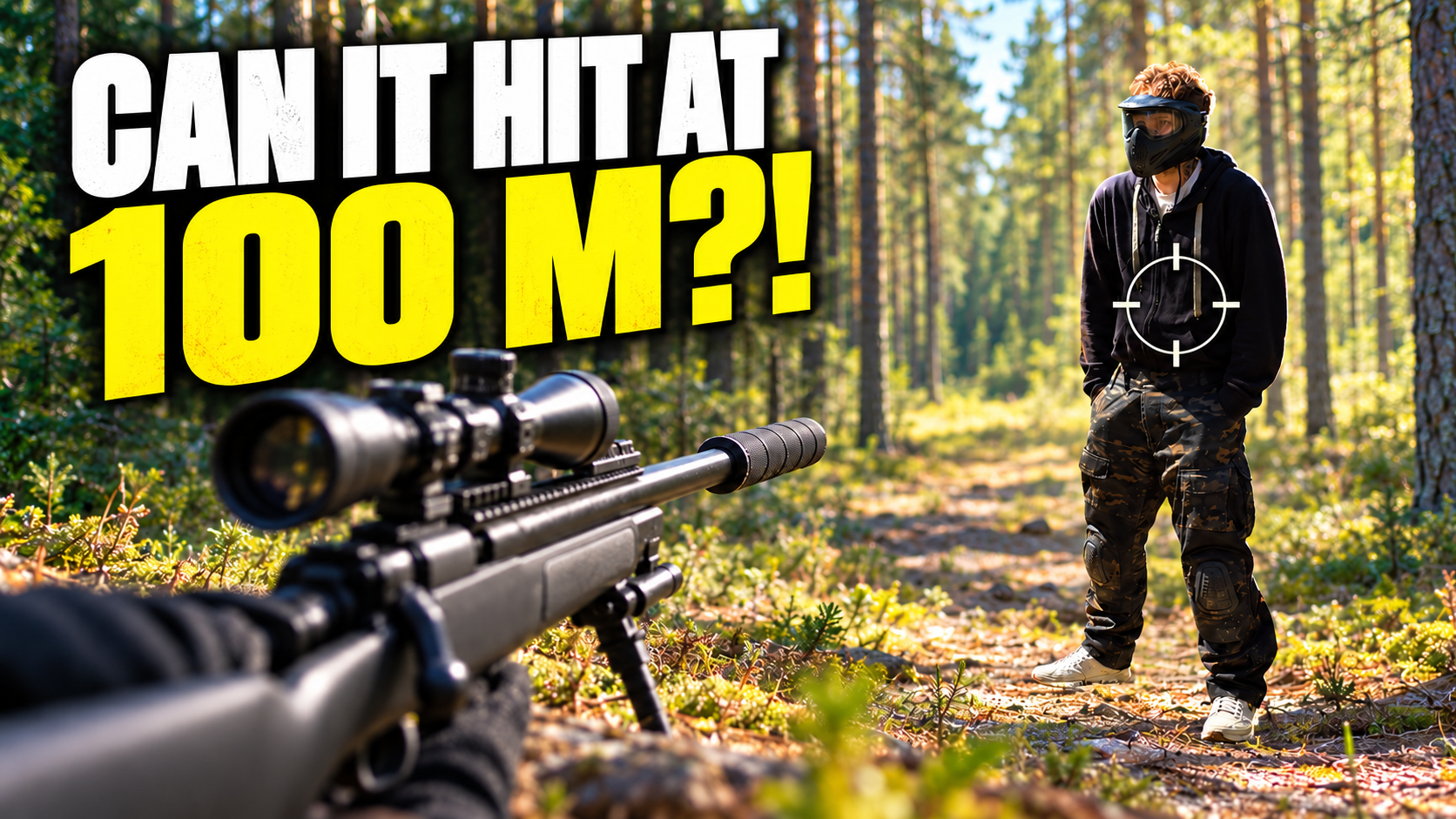
Can an airsoft gun hit at 100 metres?
A hit at 100 metres is possible with a carefully tuned long-range setup and favourable conditions, but 100 metres should not be considered normal effective range for an airsoft gun.
In our test, the 3 J VSR firing 0.45 g BBs was still producing good hits at 90 metres. The 2.7 J DMR firing 0.40 g BBs reached 85 metres, but its spread was already large enough that repeating the hit was difficult.
Whenever someone says their airsoft gun “shoots 100 metres”, it is worth asking what that actually means:
- Does the BB physically travel 100 metres?
- Has the player achieved a single hit at 100 metres?
- Can the gun produce repeatable hits at 100 metres?
Those are three very different claims.
How can you increase the effective range of your airsoft gun?
If you want more useful range, increasing muzzle energy should not automatically be the first step. Start by making the existing setup work as consistently as possible.
- Use high-quality BBs. Consistent BBs make the hop-up and trajectory more predictable.
- Test a suitable heavier BB weight. Especially outdoors, a heavier BB can improve stability and long-range performance if the hop-up can lift it properly.
- Adjust the hop-up carefully. Look for a predictable, relatively flat trajectory without excessive rise at the end.
- Check consistency. Large variations in muzzle energy or trajectory should be solved before chasing more power.
- Only then consider upgrades. Increasing energy without solving hop-up or consistency problems may simply make an inaccurate BB travel farther.
Frequently asked questions about airsoft range
How far does a normal airsoft gun shoot?
There is no single range for a “normal” airsoft gun. In our test, rifle-type setups produced hits between approximately 56 and 85 metres, but their muzzle energies ranged from 1.1 J to 2.7 J and their consistency at those distances varied considerably. Treat these figures as examples rather than guaranteed ranges for other guns.
How far can an airsoft pistol shoot?
In our test, the 0.89 J Umarex Glock 19 with 0.32 g BBs reached 55 metres and the 1.1 J NOVRITSCH SSX23 with 0.36 g BBs reached 65 metres. Different pistols can perform very differently depending on hop-up, power, BB weight, gas and temperature.
How far can an airsoft sniper rifle shoot?
Our 3 J VSR firing 0.45 g BBs produced good hits at 90 metres in the test. That does not mean every sniper rifle has a 90-metre effective range. Power, hop-up, BB choice, consistency and weather conditions all matter.
Does BB weight affect airsoft range?
Yes. A suitably heavier BB can retain velocity and stability better over long distances, but the hop-up must be able to apply enough consistent backspin. A BB that is too heavy for the setup can reduce range instead.
Does higher muzzle energy increase airsoft range?
It can increase the potential range, but the relationship is not linear. Our 1.1 J SSX23 reached 65 metres, while the 3 J VSR reached 90 metres. A higher-powered gun still needs a good hop-up, suitable BBs and consistent operation to convert that energy into useful effective range.
Does inner barrel length determine airsoft range?
No. Inner barrel length can affect muzzle energy and efficiency depending on the setup, but it does not directly determine effective range. Hop-up, BB choice and consistency are usually more important for long-range hits.
Is an HPA gun always more accurate at long range than an AEG?
No. HPA systems can offer excellent consistency, but the power source by itself does not guarantee better range or accuracy. A well-adjusted AEG can outperform a poorly set-up HPA gun, and vice versa.
Conclusion: how far can an airsoft gun really shoot?
Our test showed just how difficult it is to describe airsoft range with a single number. The 0.89 J Glock with 0.32 g BBs reached 55 metres, the 1.1 J SSX23 with 0.36 g BBs reached 65 metres, the 1.1 J AKX with 0.32 g BBs reached 56 metres, the 1.3 J M16 with 0.32 g BBs reached 73 metres, the 1.7 J MTW with 0.36 g BBs was highly consistent at 70 metres, the 2.7 J DMR with 0.40 g BBs reached 85 metres and the 3 J VSR with 0.45 g BBs produced good hits at 90 metres.
But the biggest lesson was not the 90-metre result. It was the difference between reaching a target and hitting it consistently.
For actual gameplay, the useful range of an airsoft gun is the distance at which the gun, BB and hop-up combination can repeatedly send BBs where you expect them to go. Muzzle energy helps, but a good hop-up, suitable BB weight and consistent operation are what turn that energy into practical range.

