
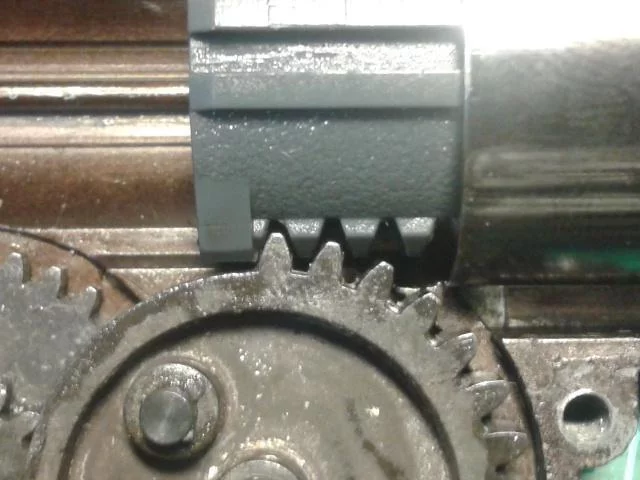
Adjusting AOE and Installing Sorbothane in an AEG Airsoft Gun
Inside an electric airsoft gun, or AEG, the piston, spring and gearset are subjected to continuous mechanical stress. With every shot, the sector gear pulls the piston backwards before the spring drives it forwards at high speed against the cylinder head.
The piston impact places stress on the cylinder head and gearbox shell. In a Version 2 gearbox, this impact is transferred particularly to the front of the shell, which is a common weak point in the design.
A Sorbothane shock-absorbing pad installed on the cylinder head can:
- cushion the piston impact;
- reduce the peak load transferred to the front of the gearbox shell;
- soften and reduce the gun's operating noise;
- reduce vibration;
- improve gearbox durability; and
- correct the angle of engagement between the piston and sector gear.
The angle of engagement can also be adjusted in other ways, but Sorbothane is a common solution in airsoft maintenance because it moves the piston backwards and cushions its impact at the same time.
How does an electric airsoft gun work?
The AEG motor drives the gearset. The sector gear engages the piston rack and pulls the piston backwards, compressing the gearbox spring.
The tappet plate, controlled by the sector gear, briefly pulls the nozzle backwards. This allows a BB that has risen from the magazine into the feed channel to enter the hop-up chamber. As the nozzle moves forwards again, it pushes the BB through the hop-up bucking lips into the firing position and seals against the hop-up bucking.
When the final pickup tooth on the sector gear releases the piston, the spring drives the piston rapidly forwards. The piston head compresses the air inside the cylinder. This air travels through the cylinder head and nozzle into the hop-up chamber, accelerating the BB through the inner barrel and out of the muzzle.
At the end of its travel, the piston head strikes the impact surface of the cylinder head. This impact is transferred through the cylinder head to the gearbox shell, particularly to the front of the shell.

What does angle of engagement, or AOE, mean?
The angle of engagement, commonly abbreviated to AOE, describes the position in which the first pickup tooth of the sector gear contacts the first main pickup tooth on the piston rack.
The first main tooth on the piston is commonly referred to as the pickup tooth.
With the correct angle of engagement, the sector gear tooth contacts the piston pickup tooth across as much of its surface as possible. The contact should not occur only at the tip, corner or lower edge of the piston tooth.
If the angle of engagement is incorrect, the sector gear begins pulling the piston from a small contact area or at an unfavourable angle. This places additional edge loading and twisting force on the first piston tooth.
The angle of engagement is affected by factors including:
- the dimensions of the gearbox shell;
- the design of the cylinder head;
- the thickness of the cylinder head's original rubber pad;
- the design of the piston head;
- the dimensions of the piston and its tooth rack;
- the diameter and tooth profile of the sector gear; and
- the thickness of any shock-absorbing material added to the cylinder head.
What can an incorrect angle of engagement cause?
An incorrect angle of engagement does not necessarily break the piston immediately. The gun may operate for a long time even when the initial contact is poor. However, continuous edge loading causes the components to wear more quickly.
Possible consequences include:
- wear or breakage of the first piston pickup tooth;
- separation of the metal tooth rack from the piston body;
- damage to the plastic piston body;
- wear on the first pickup tooth of the sector gear;
- the piston tilting as the pickup cycle begins;
- a sharper operating sound from the gears and piston; and
- a shorter service life for the piston or gearset.
A steel-tooth piston does not correct an incorrect angle of engagement by itself. A stronger tooth rack may tolerate the load better, but the stress may instead be transferred to the piston body, sector gear or gearbox shell.
Why can a Version 2 gearbox crack at the front?
In a Version 2 gearbox, the cylinder head sits at the front of the shell. The piston impact is transferred through the cylinder head to this area with every shot.
The front of the shell, particularly the front corners of the cylinder window, is a common weak point in a Version 2 gearbox. When the gun is used for a long time without effective impact cushioning, repeated short impact peaks can fatigue the material and eventually crack the shell.
The risk is particularly high when the gun has:
- a powerful spring;
- a heavy piston or piston head;
- a high rate of fire;
- strong spring pre-cocking;
- a thin or lower-quality gearbox shell;
- sharp internal corners at the front of the shell; or
- is used in cold temperatures.
Sorbothane does not make the shell unbreakable, but it reduces the instantaneous impact peak transferred to the front of the gearbox. It is particularly useful in a Version 2 gearbox when the aim is to reduce the risk of the shell cracking.

What is Sorbothane®?
Sorbothane is a rubber-like viscoelastic polyurethane material with a particularly strong ability to absorb impacts and vibration.
Conventional elastic rubber flexes during an impact and returns a large proportion of the energy back into movement. Sorbothane instead converts part of the impact energy into a small amount of heat. As a result, the impact is not returned to the structure as strongly in the form of vibration.
Sorbothane hardness is normally measured using the Shore 00 scale. This is not the same scale as Shore A, which is commonly used for harder rubber components.
What does the impact-response graph show?
The key principle shown by the graph below is simple: the higher and narrower the impact peak, the greater the instantaneous stress placed on the structure.
- The blue curve represents the short and powerful original impact impulse. In an AEG, this can be compared with a situation in which the piston impact is transferred almost directly into the gearbox shell.
- The yellow curve represents the response of neoprene. Neoprene flexes and reduces the initial peak, but the energy returns as several later oscillations. It provides a useful illustration of conventional rubber-like cushioning, although the original cylinder-head pad is not necessarily made from neoprene.
- The red curve represents the response of 50 Shore 00 Sorbothane. The impact peak is lower and the load is spread across a longer period of time.
In an AEG gearbox, this means that Sorbothane softens the piston impact and reduces the sudden stress peak transferred to the front of the shell.
The graph is not a measurement taken from an airsoft gearbox. It is a general comparison illustrating how the materials behave under impact loading.

What does Sorbothane do inside an AEG gearbox?
Sorbothane is installed on the impact surface of the cylinder head, where the piston head rests and strikes at the end of its travel.
When correctly installed, Sorbothane has three practical functions:
-
It cushions the piston impact. The piston's energy is not transferred to the gearbox shell as such a sharp impact peak.
-
It reduces operating noise. The piston-head impact becomes softer and less sharp.
-
It moves the piston backwards. This makes it possible to adjust the angle of engagement between the piston and sector gear.
The angle of engagement can also be adjusted by installing spacers behind the piston head. Sorbothane is commonly used because the same modification provides both correct engagement geometry and effective impact cushioning.
Why is a protective plate required over the Sorbothane?
Sorbothane is a soft and flexible material. If the piston head strikes the Sorbothane directly, the material will begin to wear and become damaged during use.
Without a protective plate, the Sorbothane may:
- compress unevenly;
- bulge around the edges;
- tear around the air channel;
- wear against the surface of the piston head; or
- separate from the adhesive bond.
A hard, flat protective plate is glued on top of the Sorbothane. The piston head strikes this plate, which distributes the load across the entire Sorbothane pad.
The correct layer order is:
- the cylinder head or its original rubber pad;
- the Sorbothane shock-absorbing pad;
- the hard protective plate; and
- the piston head.
Atom Custom Sorbothane Pad and Protective Plate
Atom Airsoft offers a ready-made Sorbothane pad and protective plate for AEG cylinder heads:
Atom Custom Sorbothane Shock-Absorbing Pad and Protective Plate, 3.50 mm × 20 mm
- Diameter: 20 mm
- Total thickness with protective plate: 3.50 mm
- Intended use: impact cushioning and AOE adjustment on AEG cylinder heads
The product is dimensioned to fit most conventional electric-airsoft-gun cylinder heads without major modification. However, cylinder heads from different manufacturers are not all identical.
On some cylinder heads:
- the air channel is not perfectly centred;
- the air-channel diameter differs from the usual size;
- the outside diameter of the impact surface is smaller;
- the original rubber pad is unusually thick; or
- the cylinder-head design prevents the pad from being installed without adjustment.
Always check the fit of the pad and the alignment of the air channel before gluing it in place.
What do you need for the installation?
- a Sorbothane shock-absorbing pad;
- a protective plate to install over the Sorbothane;
- a flexible cyanoacrylate adhesive, such as Loctite Flex Gel;
- a sharp knife or a suitable punch;
- a file or rotary tool for modifying the piston teeth;
- cleaning materials for the bonding surfaces; and
- a small clamp or another method of holding the components tightly together while the adhesive cures.
Installing Sorbothane step by step
1. Open the gearbox and inspect the components
Place the cylinder, cylinder head, piston, piston head and sector gear into one half of the gearbox shell.
At the same time, inspect:
- the condition of the front of the gearbox shell;
- the cylinder-head impact surface;
- the condition of the piston head;
- the first piston pickup tooth;
- the attachment of the piston tooth rack;
- the pickup teeth on the sector gear; and
- whether the piston moves freely inside the gearbox shell.
2. Check the original angle of engagement
Press the piston forwards against the cylinder head and slowly rotate the sector gear by hand towards the piston's first main pickup tooth.
Check:
- where the first sector-gear tooth makes contact;
- whether it contacts only the corner of the piston tooth;
- how large the contact area is;
- whether the sector gear pushes the piston at an angle; and
- how far the piston needs to be moved backwards.
3. Decide whether to install the Sorbothane over the original rubber pad or in its place
The Sorbothane may be glued over the cylinder head's original rubber pad or installed in place of the original pad.
Installation over the original rubber pad is possible when:
- the original pad is undamaged;
- it is securely attached;
- the impact surface is flat;
- the total thickness does not move the piston too far backwards; and
- the angle of engagement becomes correct.
The old pad should be removed if it is loose, uneven or damaged, or if the combined thickness would become excessive.
4. Test-fit the Sorbothane and protective plate
Place the Sorbothane on the cylinder-head impact surface without adhesive. Position the protective plate on top of it.
Make sure that:
- the Sorbothane and protective plate are centred;
- the air channel remains completely open;
- the air-channel opening is not too small;
- the edges do not extend between the cylinder wall and cylinder head;
- the protective plate is not tilted; and
- the piston head contacts the plate evenly.
When the air-channel opening needs to be enlarged, remove material gradually using a sharp tool. The opening should match the cylinder-head air channel and must not restrict airflow.
5. Clean the bonding surfaces
Remove grease, dirt, loose rubber and old adhesive from the cylinder-head impact surface. The surface should be dry, clean and as flat as possible.
Avoid cleaning products that may damage the Sorbothane or soften a plastic cylinder head.
6. Glue the Sorbothane and protective plate
Apply a thin and even layer of flexible cyanoacrylate adhesive to the cylinder-head impact surface.
The installation order is:
- glue the Sorbothane over the original cylinder-head pad or in its place;
- centre the Sorbothane carefully;
- make sure the air channel remains completely open;
- glue the protective plate on top of the Sorbothane;
- centre the protective-plate opening over the air channel; and
- clamp the complete assembly firmly against the cylinder head while the adhesive cures.
Clamping the parts during curing is important. The Sorbothane and protective plate must remain flat and firmly pressed against the cylinder-head impact surface until the adhesive has fully cured.
A small clamp and flat protective blocks can be used. Make sure the clamp does not push the Sorbothane or protective plate sideways.
Do not use too much adhesive. Excess adhesive may:
- enter the air channel;
- create an uneven impact surface;
- change the overall thickness;
- move the protective plate out of alignment; or
- enter the inside of the cylinder.
Allow the adhesive to cure completely before making the final AOE check or reassembling the gearbox.
What does correctly installed Sorbothane look like?


Why must a piston tooth be shortened or removed?
The Sorbothane moves the piston's resting position backwards. This causes the first sector-gear pickup tooth to meet the piston's first main pickup tooth earlier.
At the same time, the next sector-gear tooth may contact the following tooth on the piston rack before the first pickup tooth has engaged correctly.
For this reason, the piston tooth immediately following the main pickup tooth must, in practice, always be shortened or completely removed when installing Sorbothane.
Airsoft technicians often refer to this as the second piston tooth. With a thicker Sorbothane installation, the following tooth may also need to be partially shortened.
Do not remove the first main pickup tooth. The tooth to be modified is the one immediately after it.
Modifying the piston tooth
Remove or shorten the tooth following the pickup tooth using a file or suitable rotary tool.
Remove material in a controlled manner and finish the edges carefully. The tooth rack should not be left with:
- sharp burrs;
- chips or cracks;
- edges that can catch on the gear; or
- heat-damaged areas that may affect the plastic piston body.
When using a rotary tool, avoid heating the metal excessively.

Check the final angle of engagement
Once the adhesive has cured and the required piston tooth has been shortened or removed, place the cylinder, cylinder head, piston and sector gear back into one half of the gearbox shell.
Press the piston forwards against the protective plate and slowly rotate the sector gear by hand.
With the correct angle of engagement:
- the first sector-gear pickup tooth contacts a broad area of the piston pickup tooth;
- contact does not occur only at the tip of the tooth;
- contact does not occur only at the lower corner of the tooth;
- the sector gear does not push the piston strongly upwards or downwards;
- the tooth following the pickup tooth does not contact the gear too early; and
- the piston begins moving straight backwards.

Rotate the sector gear through the complete cycle
Checking the initial contact alone is not enough. Rotate the sector gear by hand through the entire operating cycle.
Make sure that:
- the sector gear engages the pickup tooth cleanly;
- the following gear teeth engage the piston rack normally;
- there is sufficient clearance at the shortened or removed tooth;
- the piston moves inside the gearbox shell without binding;
- the sector gear pulls the piston fully backwards;
- the sector gear releases the piston normally;
- the piston can return fully against the protective plate;
- the Sorbothane does not bulge sideways;
- the protective plate does not move; and
- the air channel remains completely open.
If the sector gear still contacts the tooth following the pickup tooth, shorten it gradually and check the movement again.
Common Sorbothane installation mistakes
The protective plate is omitted
This is one of the most common mistakes. Direct impact from the piston head quickly wears the soft Sorbothane. Always use a hard protective plate over the Sorbothane.
The air-channel opening is too small
An opening that is too small restricts airflow. This can reduce muzzle energy and cause inconsistent shot-to-shot performance.
The opening should match the cylinder-head air channel and be carefully centred.
The Sorbothane is installed without checking the angle of engagement
Sorbothane moves the piston backwards, but the result must always be checked by rotating the sector gear by hand. Simply gluing the pad into place does not guarantee the correct AOE.
The piston tooth is not shortened or removed
After the Sorbothane moves the piston backwards, the following sector-gear tooth may collide with the piston rack. The tooth following the pickup tooth must, in practice, always be shortened at minimum.
The Sorbothane or protective plate is glued at an angle
A crooked installation creates an uneven impact surface. The piston head then strikes only part of the protective plate, causing the Sorbothane to compress unevenly.
Too much adhesive is used
Excess adhesive may enter the air channel, change the total thickness or create an uneven impact surface.
The adhesive is not allowed to cure under pressure
The Sorbothane and protective plate must remain firmly clamped against the cylinder head for the entire curing period.
If the adhesive is allowed to cure without pressure:
- gaps may remain under the Sorbothane;
- the impact surface may become uneven;
- the protective plate may move sideways; or
- the adhesive bond may fail quickly during use.
Allow the adhesive to cure completely before reassembling the gearbox.
What can happen if the Sorbothane installation is too thick?
An excessively thick shock-absorbing pad may move the piston too far backwards.
Possible consequences include:
- the angle of engagement becoming incorrect again;
- unnecessary modification of several piston teeth;
- a shorter piston stroke;
- reduced effective cylinder volume;
- lower muzzle energy;
- the sector gear contacting the wrong piston teeth;
- excessive compression of the Sorbothane; or
- failure of the adhesive bond.
The 3.50 mm total thickness of the Atom Custom pad fits most conventional AEG configurations, but every gearbox and component combination must still be checked individually.
Reassembling and testing the gearbox
Once the sector gear can be rotated by hand through the complete operating cycle without collisions, reassemble the gearbox normally.
Begin testing with semi-automatic shots and listen to the operating sound. Correctly installed Sorbothane should normally make the piston impact softer and less sharp.
Stop testing immediately if:
- you hear a metallic collision inside the gearbox;
- the motor stops or is placed under unusual load;
- the piston does not return;
- the gearbox locks up; or
- the operating sound suddenly changes.
Measure the gun's muzzle energy after the installation. Sorbothane slightly shortens the piston's effective stroke, so the muzzle energy may change.
Inspect the installation after use
A new Sorbothane pad may settle and compress slightly during its first period of use. Inspect the installation during the next service.
Check in particular:
- whether the Sorbothane has compressed evenly;
- whether the protective plate has remained in position;
- whether the adhesive has separated around the edges;
- whether the air channel remains open;
- whether the Sorbothane shows any tears;
- whether the protective plate shows an uneven impact mark; and
- whether the angle of engagement has remained correct.
Installation checklist
- The gearbox shell and internal components are undamaged.
- The original angle of engagement has been checked.
- The Sorbothane fits the cylinder-head impact surface.
- The Sorbothane and protective plate are centred.
- The air channel is large enough and completely open.
- A thin and even layer of adhesive has been used.
- The Sorbothane and protective plate were clamped firmly during curing.
- The adhesive has been allowed to cure completely.
- The tooth following the pickup tooth has been shortened or removed.
- The final angle of engagement has been checked.
- The sector gear has been rotated by hand through the complete cycle.
- The piston moves without binding.
- The gun has been tested and chronographed after reassembly.
Summary
Sorbothane is one of the most useful small modifications for a Version 2 gearbox in particular. It does not strengthen the shell by adding structural material. Instead, it improves durability by reducing the stress peak caused by the piston impact.
Correctly installed Sorbothane:
- cushions the piston impact;
- reduces stress on the front of the gearbox shell;
- softens and reduces the gun's operating noise;
- helps protect the weak front section of a Version 2 gearbox; and
- corrects the angle of engagement between the piston and sector gear.
The most important parts of the installation are using a protective plate, keeping the air channel open, modifying the tooth following the piston pickup tooth and allowing the adhesive to cure under firm pressure.
Simply gluing a Sorbothane pad into place is not enough. The angle of engagement and the complete sector-gear operating cycle must always be checked by hand before the gearbox is reassembled.
Product and further information
- Atom Custom Sorbothane Shock-Absorbing Pad and Protective Plate, 3.50 mm × 20 mm
- Sorbothane material properties
- Sorbothane technical data and performance curves
This article is a technical installation guide produced by Atom Airsoft. Gearbox, cylinder-head, piston and gear dimensions vary, so the compatibility of the installation must always be checked in the specific gearbox before the gun is used.


