
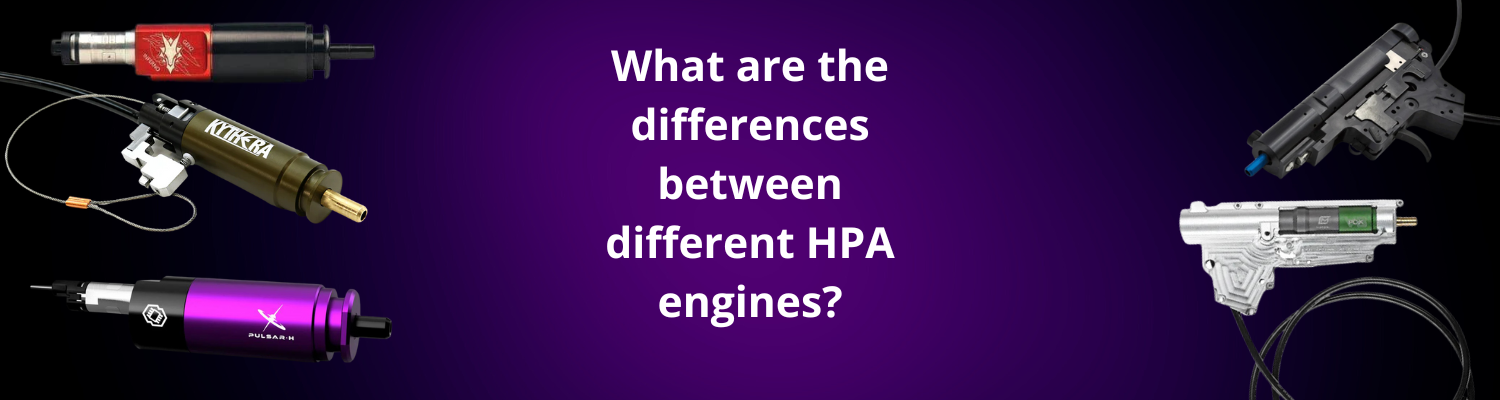
HPA Engines Compared: Beyond Spec Sheets – A Player’s Perspective
When comparing HPA engines, it’s easy to get stuck in model lists and spec tables that don’t really tell you the most important thing: how the different systems actually feel in use and what they’re truly best suited for. This article is written from a player’s point of view so you can understand the differences in how HPA engines operate without having to read dozens of forum threads or guess which one is “the right” choice.
We’ll go through the different operating principles (open bolt, closed bolt, and hybrid) as well as mechanical HPA engines, and explain how these solutions affect the gun’s behavior in practice. We’ll also compare 1-solenoid and 2-solenoid systems, because the number of solenoids isn’t just a technical detail — it often shows up clearly in real-world use, especially in adjustability and how forgiving the engine is with different builds.
After reading this article, you’ll be able to identify which operating principle best serves your playstyle and what to pay attention to when comparing engines. The goal isn’t to name one “best” engine for everyone, but to give you a clear decision-making foundation so you can avoid the most common mistakes and get the HPA setup you actually want.
Open Bolt
In HPA engines, open bolt operation basically means the nozzle rests in the rearward position when idle and does not hold a BB ready in the hop-up chamber. At the moment of firing, the engine effectively does two things in quick succession within the same cycle: it feeds the BB into the hop-up and fires almost immediately after the nozzle has moved forward. A very good and extremely common example of open bolt operation is the PolarStar JACK, which represents classic open bolt thinking and has been many players’ first contact with HPA conversions.
From a player’s perspective, the key question is what it really means that the shot happens “on the move.” The first noticeable effect is how sensitive the whole setup is to small details in the build. Because the BB is only seated into the hop-up during the firing cycle, the alignment of the hop-up, the tightness of the bucking, and how well the nozzle fits become much more critical. If the nozzle isn’t perfectly centered or the hop-up chamber is even slightly misaligned, the BB can settle differently from shot to shot. This may not show up as major spread at short ranges, but at longer distances it can start to feel like inconsistency.
It’s important, however, to separate two things: open bolt does not automatically mean inaccurate. Quite the opposite — when everything is built correctly, an open bolt engine can be extremely consistent and precise. The potential impact on accuracy with open bolt comes specifically from the fact that the BB’s starting position (seating on the hop-up lips, contact with the bucking, and air seal) forms very quickly during the same cycle.
Closed Bolt
Closed bolt operation starts from the opposite idea: the nozzle rests in the forward position when idle and holds the BB ready in the hop-up chamber before the shot. In practice, this means that at the moment of firing, the engine doesn’t need to first feed and seat the BB — it can focus purely on the shot itself. A great example of a closed bolt engine is the PolarStar Fusion Engine, which has long been known precisely for its closed bolt-style operation and around which a lot of real-world experience from different builds has accumulated.
From a player’s perspective, the clearest benefit of closed bolt is consistency: since the BB is already seated against the hop-up bucking in the same position before every shot, the starting conditions for each round are as identical as possible. This shows up especially in semi-auto focused play and at longer ranges, where even tiny differences in BB seating or air seal start to appear in the grouping. That’s why closed bolt engines are often seen as natural choices for DMR-style play, where the quality and repeatability of the first shot are emphasized.
Hybrid
In this context, hybrid operation practically means that the engine behaves in many ways like open bolt (cycling and adjustment logic), but it adds one crucial extra step: the BB is fed into the hop-up, given time to settle into place, and only then does the shot happen. A good example of this is the Wolverine Inferno Gen2, whose entire design philosophy is to reduce the classic “open bolt problem” (i.e., the BB not always settling in exactly the same way before firing) without moving fully into the pure closed bolt world. The practical feel comes from the fact that the shot doesn’t happen the instant the nozzle is still actively pushing the BB into the hop-up; instead, the engine creates a small “settling moment” before releasing the air.
This is the point that directly ties into accuracy and consistency. In open bolt designs, possible accuracy variation often stems from the BB’s starting conditions (position on the hop-up lips, contact surface with the bucking, and seal) forming while still in motion. In a hybrid design, the goal is for the BB to have time to stabilize against the hop-up lips before the air is released, resulting in more even backspin and fewer “micro-differences” from shot to shot.
1-Solenoid vs. 2-Solenoid HPA Engines
The difference between 1- and 2-solenoid HPA engines isn’t just a technical detail — it tells you whether the nozzle movement and the actual firing can be controlled independently of each other. In practice, this affects how much adjustment range the engine has, how forgiving it is with different builds, and how it feels in your own playstyle.
A great example of a 2-solenoid approach is the GATE Pulsar D2. When the nozzle and firing are separately controlled, the engine can better separate “seating the BB into the hop-up” and “releasing the air” into their own phases. For players, this usually shows up as wider fine-tuning possibilities for feed timing and dwell. The downside is that tuning becomes more technical in nature — there are more variables, and it’s easier to miss the sweet spot if you over-tune the setup.
A good example of a 1-solenoid implementation is the Wolverine Inferno Gen2. In a single-solenoid engine, one solenoid controls the main cycle, and the internal design of the engine determines how feed and firing overlap. In practice, this often means a more straightforward overall package: adjustments feel like they’re done “in one direction,” and finding a good baseline setting is easier for many people. The trade-off is that because the relationship between nozzle movement and firing isn’t fully independently controlled by two solenoids, the final result relies a bit more on the mechanical compatibility being reasonably well-matched.
Mechanical vs. Electronic?
Mechanical HPA engines differ from electronically controlled ones primarily in what actually triggers the shot. In an electronic engine, the FCU (Fire Control Unit) controls the solenoid(s), and timing happens at millisecond level. In a mechanical engine, the trigger pull physically opens the valve without any electronics.
In practice, the differences show up in three main areas. First, trigger feel: electronic can be very light and “switch-like,” while mechanical often feels more mechanical and longer because the trigger actually moves the system. Second, adjustment and tuning: electronic offers far more adjustment range and fine control, while mechanical is more straightforward. Fewer settings, but also fewer ways to mess things up badly. Third, everyday use and failure modes: mechanical removes battery and electronics variables, making it simpler in its own way; electronic brings electronics into the mix but often gives more tools to make behavior consistent and repeatable.
As a choice, it boils down to this: go mechanical if you want a simple, worry-free solution without electronics; go electronic if you want maximum control and tuning potential tailored to your playstyle.


