

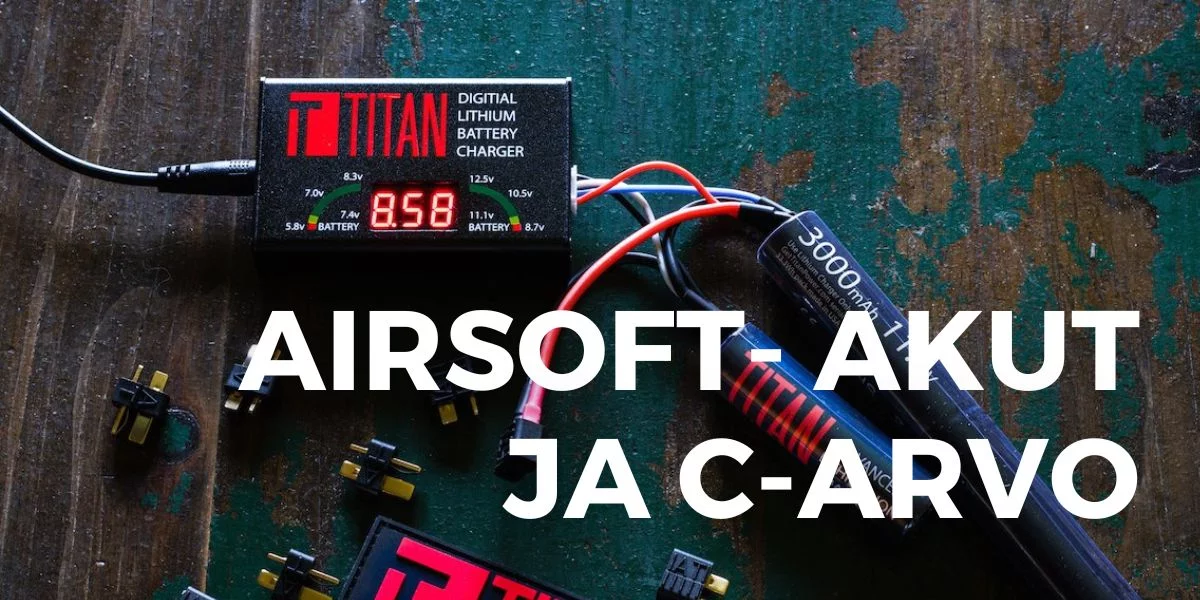
Airsoft Battery Buying Guide – Understanding C-Rating, Capacity and Voltage
An airsoft battery may be labelled, for example, 1500 mAh, 11.1 V and 30C. Voltage and capacity are familiar to many players, but the C-rating still causes confusion.
The original idea behind this article came from a common claim that 3000 mAh 16C Titan Power Li-Ion batteries were weak simply because the printed C-rating was only 16C. The calculation shows why that conclusion is incorrect:
- 3000 mAh 16C: 3.0 Ah × 16 = 48 A
- 1500 mAh 30C: 1.5 Ah × 30 = 45 A
A higher C-number does not automatically mean greater current capability. Battery capacity and C-rating must always be considered together.
This guide explains C-rating, voltage, capacity, battery chemistry and practical current capability, and helps you choose between 7.4 V and 11.1 V batteries for an AEG.
Related videos
The quick answer: calculate amps instead of looking only at the C-rating
The battery's calculated discharge current is found by multiplying its capacity in amp-hours by its C-rating:
Discharge current (A) = capacity (Ah) × C-rating
Convert milliamp-hours to amp-hours by dividing the number by one thousand:
- 1000 mAh = 1.0 Ah
- 1500 mAh = 1.5 Ah
- 2000 mAh = 2.0 Ah
- 3000 mAh = 3.0 Ah
A 3000 mAh 16C battery therefore has a calculated discharge current of 48 A. A smaller 1500 mAh battery needs a 32C rating to reach the same calculated 48 A.
The motor draws the current required by its load. The battery does not force its C-rated amperage into the gun. It must simply be capable of supplying the requested current without excessive voltage sag, overheating or a major loss of performance.
What does the C-rating mean?
The C-rating, or C-rate, expresses discharge current relative to battery capacity. A 1C discharge rate theoretically discharges the battery's nominal capacity in one hour.
- 1C: theoretical discharge time of 60 minutes
- 6C: theoretical discharge time of 10 minutes
- 20C: theoretical discharge time of 3 minutes
- 60C: theoretical discharge time of 1 minute
These are mathematical reference values. Actual runtime differs because battery voltage drops under load and use stops before complete discharge.
Why is a 16C Titan Power battery not automatically sluggish?
When a 3000 mAh Titan Power battery is marked 16C, it is easy to compare that number directly with a 30C LiPo and assume the Li-Ion battery is much weaker. That comparison ignores capacity.
| Battery | Capacity | C-rating | Calculated discharge current |
|---|---|---|---|
| Titan Power Li-Ion | 3000 mAh / 3.0 Ah | 16C | 48 A |
| Example LiPo | 1500 mAh / 1.5 Ah | 30C | 45 A |
| Example LiPo | 1500 mAh / 1.5 Ah | 32C | 48 A |
The calculated current capability of a 3000 mAh 16C battery is therefore similar to that of a 1500 mAh 32C battery. The larger capacity can also provide considerably more shots per charge.
The calculation alone still does not describe real performance. Cell internal resistance, wiring, connectors, temperature, state of charge and battery condition affect how well voltage is maintained under load.
Browse Titan Power batteries at Atom Airsoft.
mAh, C-rating and voltage describe different things
mAh describes capacity
Milliamp-hours describe the battery's electrical charge capacity. A larger capacity normally provides more shots per charge when voltage, gearbox and use are comparable.
mAh alone does not show how much current the battery can supply.
C-rating describes relative discharge current
The same C-rating produces different amp values in batteries of different capacities:
- 1000 mAh 20C = 20 A
- 2000 mAh 20C = 40 A
- 3000 mAh 20C = 60 A
Voltage affects cycling speed
Battery voltage affects motor speed, trigger response and rate of fire. An 11.1 V battery normally cycles the same build faster than a 7.4 V battery.
C-rating does not replace voltage. Two batteries may have the same calculated current capability but behave differently in the gun when one is 7.4 V and the other is 11.1 V.
7.4 V or 11.1 V LiPo or Li-Ion?
7.4 V
A 7.4 V LiPo or Li-Ion battery is a good general choice for a standard AEG, a beginner or a build whose electrical and mechanical limits are not fully known.
Typical advantages include:
- moderate rate of fire;
- lower risk of overspin and double firing with a light spring;
- less mechanical stress; and
- a straightforward starting point for battery selection.
Browse 7.4 V LiPo and Li-Ion batteries.
11.1 V
An 11.1 V LiPo or Li-Ion battery normally improves trigger response and increases rate of fire. It is suitable for a gun whose electrical system and gearbox are designed for that voltage.
An 11.1 V battery may cause problems when:
- the gun uses a light spring;
- the motor and gears cycle too quickly for the piston to return;
- the gun does not have effective active braking;
- the gearbox overspins;
- the piston or gears are not suited to the increased speed; or
- the manufacturer did not design the model for an 11.1 V battery.
Browse 11.1 V LiPo and Li-Ion batteries.
Can 7.4 V and 11.1 V Titan Power batteries be used in Specna Arms FLEX and CORE AEGs?
Specna Arms FLEX and CORE product lines include several generations, electrical systems and gearbox versions. A completely universal answer cannot therefore be given from the product-line name alone.
A 7.4 V Titan Power battery is normally the safer general choice for a standard gun and especially for a build using a light spring around the M90 range.
An 11.1 V Titan Power battery provides faster cycling and sharper trigger response. It can be used when the specific model and electrical system are designed for 11.1 V and the gearbox load is appropriate.
With a light M90-level spring and an 11.1 V battery, the motor and gears may cycle so quickly that the gearbox does not stop at the intended point. Possible symptoms include:
- overspin;
- two shots from one trigger pull;
- inconsistent semi-automatic operation; or
- timing problems within the gearbox.
Practical recommendation:
- Choose 7.4 V when the gun is standard, the spring is light or 11.1 V compatibility is uncertain.
- Choose 11.1 V when the manufacturer or retailer approves it, the gun has a suitable MOSFET/ETU and faster trigger response is desired.
- If the gun double fires or cycles inconsistently on 11.1 V, switch to 7.4 V or have the gearbox and active braking checked.
What about 8.4 V and 9.6 V NiMH batteries?
NiMH is a traditional and straightforward battery option. It is often physically larger and its voltage behaves differently under load compared with LiPo or Li-Ion.
8.4 V NiMH
An 8.4 V NiMH battery suits many older or moderately cycling standard AEGs. Cycling is usually calm, although trigger response may be slower than with a good 7.4 V lithium battery.
Browse 8.4 V NiMH batteries.
9.6 V NiMH
A 9.6 V NiMH battery normally provides faster cycling than an 8.4 V model. It can be a useful choice when NiMH is preferred but 8.4 V performance feels too modest.
Browse 9.6 V NiMH batteries.
Nominal voltage alone should not be used to assume that a 9.6 V NiMH directly matches a particular LiPo or Li-Ion battery. Battery chemistry and internal resistance affect practical performance.
LiPo, Li-Ion or NiMH?
| Battery type | Strengths | Points to consider | Typical user |
|---|---|---|---|
| LiPo | Strong current capability, compact size, wide selection | Requires the correct charger and careful handling | General use and performance builds |
| Li-Ion | High capacity for its size and long runtime | The C-number may look low, so amps should be calculated | Players who value long runtime |
| NiMH | Traditional and straightforward option | Often larger and heavier with more voltage sag | Standard AEGs and users seeking a simple solution |
Continuous and burst C-ratings
Some batteries list two ratings, such as 25C / 50C. The first usually refers to continuous discharge and the second to short-term burst discharge.
An AEG motor draws a high current peak during startup. Burst capability is therefore useful, but the time limit and test method for a burst rating are not always stated.
Full-auto fire, rapid semi-auto use, pre-cocking and a heavily loaded gearbox repeatedly stress the battery. The continuous C-rating is therefore a safer starting point for comparison, with burst rating treated as supplementary information.
How does an AEG load the battery?
When the trigger is pulled, the motor is initially stationary. Starting it requires a short, high current peak. Once the motor and gearset are moving, current normally falls to a lower running level.
Current demand is affected by factors including:
- motor design and condition;
- spring strength;
- gear ratio and shimming;
- motor height;
- resistance in piston movement;
- pre-cocking and active braking;
- battery voltage;
- wiring and connector resistance; and
- temperature.
A poorly shimmed, excessively tight or faulty gearbox may draw considerably more current than a correctly adjusted gun. A larger battery does not repair a mechanical fault.

Why can batteries with the same C-rating perform differently?
Two batteries marked with the same capacity and C-rating may not perform identically. Actual performance is affected by:
- cell internal resistance;
- cell quality and age;
- state of charge;
- operating temperature;
- wire thickness;
- connector type and condition;
- solder-joint quality; and
- the manufacturer's test method.
High internal resistance causes voltage sag and heating under load. A battery may therefore feel sluggish in an AEG even when the printed C-rating appears sufficient.
Can a high C-rating be harmful?
A high C-rating does not force excessive current into the gun. The motor draws current according to its load.
A battery with strong current capability maintains voltage better under load. This may improve trigger response and increase rate of fire compared with a weaker battery.
Strong current capability can also make gearbox weaknesses more obvious. It does not protect against excessive voltage, incorrect gearing, a weak piston or poor wiring.
Quick battery selection chart
| Situation | Good starting point | Why? |
|---|---|---|
| Standard gun or first AEG | 7.4 V LiPo / Li-Ion | Moderate cycling speed and low overspin risk |
| Light M90-level spring | 7.4 V LiPo / Li-Ion | 11.1 V may cycle the gearbox too quickly |
| 11.1 V-compatible MOSFET/ETU gun | 11.1 V LiPo / Li-Ion | Fast trigger response and higher rate of fire |
| Long game day and high-capacity requirement | High-capacity Li-Ion | Many shots even with a moderate C-number |
| Traditional standard gun without a lithium battery | 8.4 V or 9.6 V NiMH | Simple and familiar solution |
Common misunderstandings
“A 16C battery is always sluggish”
No. C-rating must be multiplied by capacity. A 3000 mAh 16C battery has a calculated 48 A capability, which is higher than the 45 A calculated for a 1500 mAh 30C battery.
“A higher C-rating always means a better battery”
Not necessarily. Actual performance also depends on internal resistance, cell quality, temperature and battery condition.
“A higher-C battery forces too much current into the gun”
No. The motor draws the current it needs. A stronger battery simply supplies it with less voltage sag.
“mAh tells you how powerful the battery is”
mAh primarily describes capacity. It does not by itself describe voltage or current capability.
“11.1 V is always better than 7.4 V”
No. Suitable voltage depends on the gun, spring, motor, gearing and electronic control system. With a light spring, 7.4 V may operate much more reliably.
Safe battery use
- Use a charger designed for the battery chemistry and cell count.
- Balance-charge LiPo and multi-cell Li-Ion batteries according to the manufacturer's instructions.
- Do not use a swollen, damaged or abnormally hot battery.
- Never short-circuit the connectors.
- Do not crush or puncture the battery or leave it in a hot vehicle.
- Monitor battery and connector temperature during use.
- Follow the storage and charging instructions supplied by the battery and charger manufacturers.
Summary
The battery C-rating describes discharge current relative to capacity, but the C-number alone does not determine whether a battery is suitable for an AEG.
Start by calculating current capability:
capacity in Ah × C-rating = calculated discharge current in amps
Then select the correct voltage, battery chemistry, capacity, size and connector. Also consider the gearbox spring, motor, gears and MOSFET or ETU system.
The best airsoft battery is not automatically the one with the highest C-number. It is a battery that physically fits, uses a voltage suitable for the gearbox and can supply the required current without excessive voltage sag or heating.

