
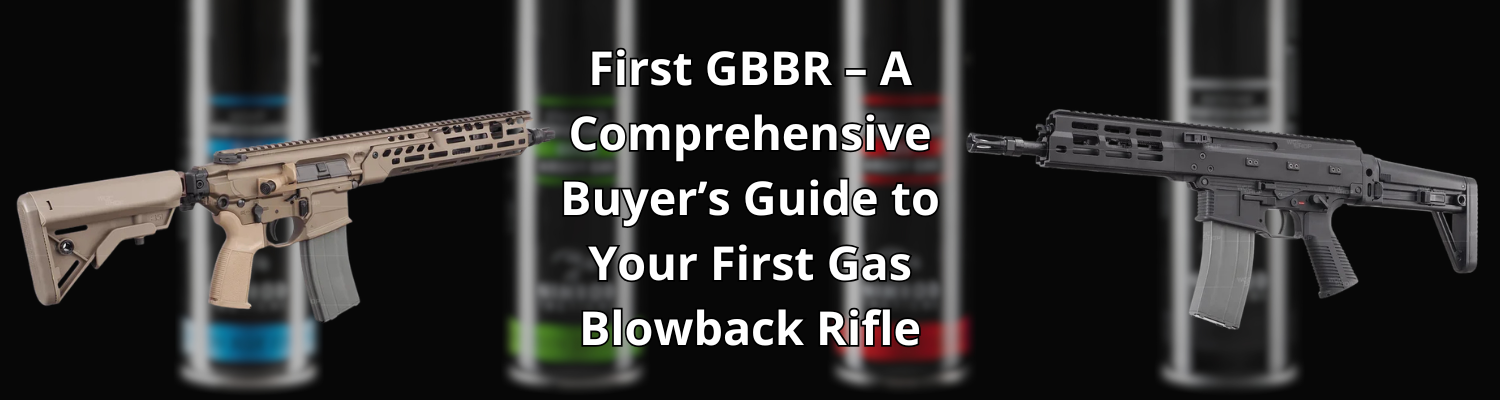
Many airsoft players are interested in GBBRs for the same reason: they offer a very different shooting and handling experience compared to an AEG. The recoil, sound, and the feel of running the gun make playing feel more mechanical, more immersive, and, for many, more rewarding. At the same time, buying your first gas rifle raises a lot of questions. What should you actually buy? How much does the full setup cost? What are the practical differences between manufacturers? And what makes sense as a first GBBR?
This article is aimed at players who are no longer completely new to airsoft, but are now considering their first gas blowback rifle. The goal is not to paint an unrealistically rosy picture of GBBRs, but not to make them seem unnecessarily difficult or intimidating either. Once you understand what you are buying and what owning a GBBR actually involves in practice, getting your first gas rifle is much easier than many people initially think.
What makes GBBRs so appealing?
For many players, the appeal of a gas blowback rifle is not just about performance, but above all about the overall experience. A GBBR does not feel like an AEG that simply shoots differently. It feels like a clearly distinct system of its own. When the gun has a moving bolt, noticeable recoil with every shot, and magazine capacities that are closer to the real thing, the entire handling experience changes.
That is exactly what makes GBBRs so interesting to many players. They add more realism to airsoft, but also make the user more involved in the process. Reloads, charging the gun, limited ammo capacity, and the overall behavior of the platform often make gameplay more deliberate. Many players describe using a GBBR as airsoft’s “hard mode.”
What is owning and using a GBBR actually like?
Your first gas rifle rarely turns out to be a bad purchase because you picked the wrong-looking model. More often, people end up regretting the purchase later because they did not fully understand the whole package beforehand. With a GBBR, you are not just buying a single gun. You are buying a complete user experience that includes the rifle itself, magazines, gas, maintenance, and a certain way of using the gun in games.
This is also the single most important thing to understand before making a purchase decision. A GBBR is not especially difficult or mysterious as a platform, but it is different to own compared to an AEG. With a gas rifle, magazines matter more, maintenance is a natural part of ownership, and weather conditions affect performance more than they do with electric guns. If you treat that as a normal part of the hobby, getting started with a GBBR is usually quite straightforward. But if you expect a gas rifle to work exactly like an AEG, just with a more realistic feel, your expectations can easily clash with reality.
A GBBR requires a bit more understanding and interest in your own gear than a traditional AEG. In return, it also gives more back to players for whom handling, realism, and mechanical feel are an important part of the hobby. For many, that is exactly why GBBRs feel so rewarding.
What should you check before buying your first GBBR?
Before you start narrowing down your first gas rifle, there are always two things you should check: magazine availability and spare parts availability.
Magazine availability is, in practice, one of the most important factors in the whole purchase. It is not enough that magazines for a certain platform or model have existed at some point if you cannot actually buy them at a reasonable price when you need them. Playing with a GBBR using only one or two magazines may work for a quick test, but in the long run it usually feels limiting. With a gas rifle, magazines are not a minor accessory. They are an essential part of the whole system. That is why, when buying your first GBBR, it is worth checking in advance whether magazines for that platform are genuinely available.
The second equally important factor is spare parts availability. A GBBR has moving and wear-prone parts. Sooner or later, something will need servicing or replacing. The more common and widely supported the platform is, the easier it usually is to find spare parts, guides, user experience, and general information. If you choose a rarer option instead, you may later discover that even finding a small replacement part takes real effort. This matters even more with a first GBBR, because the platform is already new to the user in other ways as well.
Once the magazine situation and spare parts support are in good shape, you are already a long way ahead. At that point, the rifle is much less likely to end up as an interesting purchase sitting on a shelf, and much more likely to become a practical and usable game setup.
A cheaper entry point or a longer-lasting setup?
When choosing your first GBBR, one of the most important questions is this: do you want to get into gas blowback rifles with as small an initial investment as possible, or do you want to invest straight away in a more durable and hassle-free setup?
Neither approach is wrong. What matters is understanding what you actually get at different price points, and where the compromises usually come from.
If the main priority is getting into GBBRs on a more modest budget, a lower-cost option can be a perfectly sensible choice. It lowers the barrier to entry and lets you get into the world of gas rifles without a major one-time investment. WE, for example, appeals to many players for exactly this reason. It can be a good way to get started, as long as the buyer understands that a lower purchase price usually does not mean the same level of ease and long-term peace of mind as more expensive alternatives. A more affordable platform is not automatically a bad one, but it may involve more compromises in quality, durability, or in how much understanding the setup demands from the user.
If, on the other hand, the goal is the most stable, long-lasting, and hassle-free setup possible, then a higher upfront price is often justified. Tokyo Marui options and VFC gas rifles are often recommended as first GBBRs for a reason. You pay more for them, but in return you usually get a more dependable package: better feel, and often a stronger long-term ownership experience. It is important to understand that the higher price is not just paying for the brand name. In many cases, you are genuinely buying a better starting point.
That is exactly why your first GBBR should be chosen based on how you want to use it, not just based on price alone. If you already know that you want to commit to gas blowback rifles in the longer term, a higher-quality option may ultimately make more sense. If you want to get started with a smaller investment and are willing to accept a few more compromises, a more affordable option can be absolutely the right choice.
What does a first GBBR actually cost?
When buying their first gas rifle, many people look first at the price of the gun itself. That is understandable, but also slightly misleading. The real cost of a GBBR is not just the rifle itself, but the whole setup built around it.
The first major additional cost is magazines. A GBBR magazine is a very different thing from a standard AEG magazine. It is a more complex component that contains gas, and its price is naturally higher. Because each GBBR magazine also holds a limited number of BBs, the single magazine included with the rifle is not enough for normal field use in practice. That is why, when budgeting for your first gas rifle, you should make room for extra magazines right from the start.
So how many magazines should you get? There is no single correct answer, because it depends on your style of play, the fields you play on, and your own preferences. What matters is understanding that a GBBR setup really starts to feel practical only once you have several magazines. One magazine is enough mainly for trying the gun out. Two or three will already get you further, but for most players, a sensible field setup means several magazines. This is something worth considering before your first purchase, so your budget is not built too optimistically around the rifle alone.
In addition to magazines, you also need gas and maintenance supplies. Individually, these are usually not huge expenses, but they are still part of normal use.
Maintenance and conditions as part of the GBBR hobby
A GBBR requires more maintenance than an AEG, but this should not be made into a bigger issue than it really is. This is not about the rifle constantly needing repairs or always being broken. It is about the fact that the system contains moving parts and seals, and their condition has a major impact on how the gun performs. Cleaning, lubrication, keeping an eye on magazine condition, and general routine maintenance are all a natural part of the package.
Someone buying their first GBBR does not need to be a mechanic to handle the necessary maintenance. It is enough to treat the gun with normal care and be willing to learn the basics. In fact, for many players this too is part of the appeal of gas blowback rifles. You get to know how your gun works in a very different way when the system is not as closed-off and “just a box that works” as an electric gun.
Finnish weather conditions are something you should still be aware of from the beginning. Temperature has a significant effect on how a gas rifle performs. In colder weather, gas behavior changes, performance becomes less consistent, and the overall shooting experience shifts along with the conditions. This does not make a GBBR a bad choice, but it is part of the nature of the platform. If you do not take this into account beforehand, your first colder game days will probably be disappointing.
Another important practical difference is ammo capacity on your kit. With a GBBR, the total number of BBs you carry is usually more limited than with an AEG, and that directly affects your pace of play. This is not necessarily a bad thing, but it does change how the gun is used. Shots often become more deliberate, and the overall character of gameplay becomes a little different. For many players, that is a big part of the appeal of GBBRs. The key is simply understanding it in advance.


